
Start Here: Critical 2026 Renewal Rules
California law sets a statewide baseline for CCW renewal training, but the details of scheduling, paperwork, and range logistics vary by county. Under Penal Code 26165(d), renewal applicants must complete 8 hours of training, which includes a 1-hour mental health component. This is shorter than the 16-hour initial training requirement, but it still involves a live-fire qualification component in most counties.
Instructors delivering this training must be DOJ-certified under Penal Code 31635. Once your application is complete, the issuing agency has up to 90 days to make an initial determination under Penal Code 26202(d), though many agencies move faster.
Because county sheriffs and police departments administer their own CCW programs, the exact steps for scheduling training, submitting documents, and applying for renewal differ from one jurisdiction to the next. This guide walks through a practical, statewide preparation checklist, with county examples labeled clearly so you know when to verify details with your own issuing agency.
Step 1: Verify Your Expiration and Eligibility
Don't assume your license runs on a full two-year term. License terms can vary based on when your original permit was issued, any administrative delays, or agency-specific practices. Pull out your physical permit or check your issuing agency's applicant portal to confirm the actual expiration date printed on your license.
While you're at it, confirm two other things:
- Disqualified person status. Penal Code 26202 lists categories of individuals who cannot hold a CCW license, including certain criminal convictions, restraining orders, and mental health holds. If your circumstances have changed since your last renewal, address this before scheduling training.
- Residency and address requirements. Most agencies require your current address to match your license record. If you've moved, check whether you need to notify your issuing agency separately or as part of the renewal packet.
Getting these two items squared away first prevents wasted time and money if an eligibility issue surfaces after you've already paid for training.
Step 2: Schedule Your 8-Hour Renewal Course
Once you've confirmed your expiration date and eligibility, it's time to book your training. Look specifically for a course labeled as an 8-hour CCW renewal course, not the 16-hour initial course. Confirm the instructor holds current DOJ certification under Penal Code 31635.
When contacting a training provider, ask directly whether the 1-hour mental health component is built into the 8-hour block or scheduled separately. Some providers split the classroom and range portions across different days, which affects your scheduling.
You can find DOJ-certified CCW renewal instructors through course directories, but it's still worth calling ahead to confirm the specific date has open seats and that live-fire qualification is included in that session rather than requiring a separate appointment.
Step 3: Prepare Your Documents for Training Day
Bring more paperwork than you think you'll need. A consolidated checklist for most California renewal applicants includes:
- Current CCW permit (the physical card or certificate)
- Government-issued photo ID matching your permit information
- Proof of current address, such as a recent utility bill or signed lease
- Automated Firearms System (AFS) record or similar firearm registration documentation for any weapon you plan to qualify with
- Any renewal application forms your issuing agency has already provided, including the BOF 4012 renewal application if your agency uses the standard state form
- County-specific supplemental forms, if applicable
Call your instructor or issuing agency a few days before training to confirm this list. Some counties, like Orange County, add firearm inspection requirements that affect what you need to bring. Others don't specify inspection at all, so don't assume the same rules apply everywhere.
Step 4: Gear Up for Live-Fire Qualification
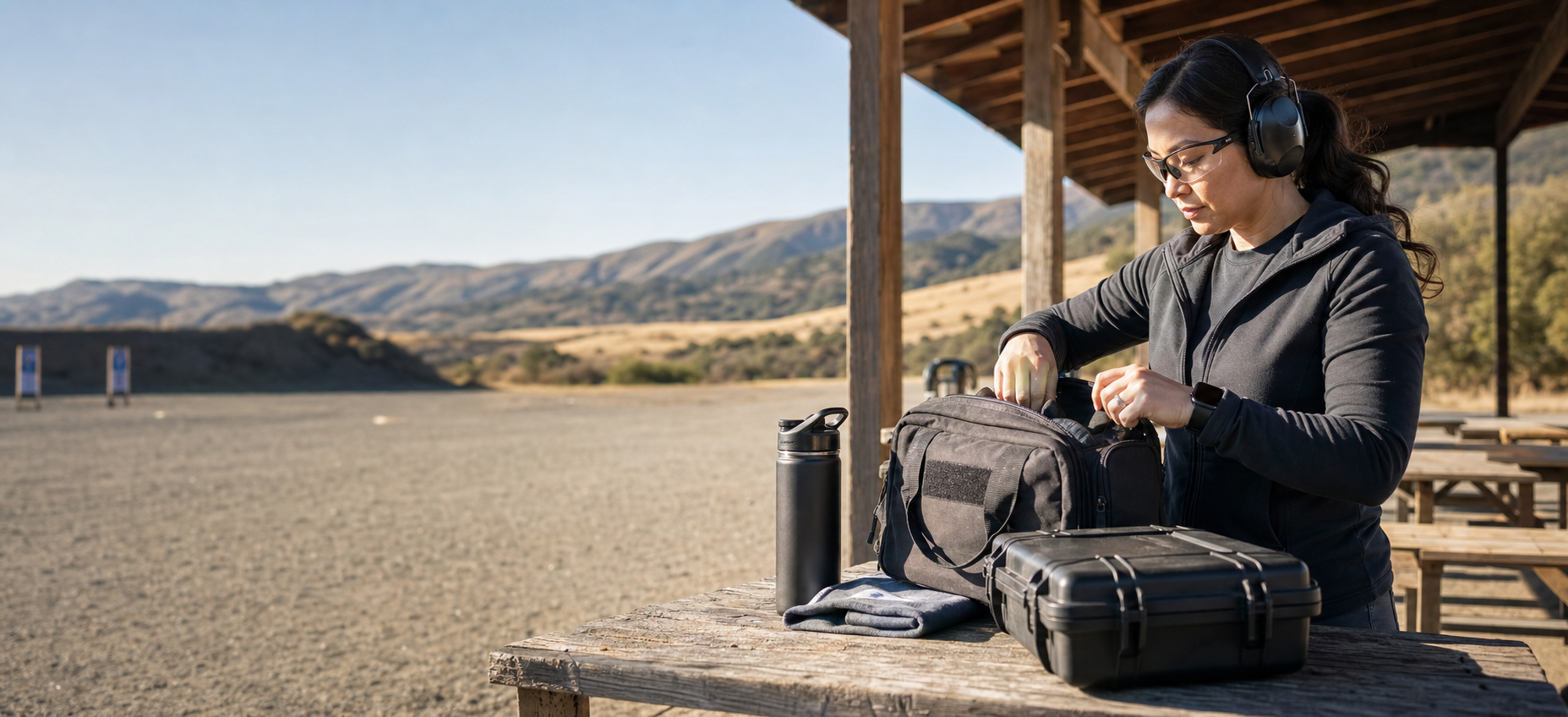
Most renewal training includes an outdoor range component, which means real-world comfort matters as much as paperwork. A simple equipment list makes the day easier:
- Eye and ear protection rated for range use, even if the facility provides loaner gear
- Closed-toe, stable footwear appropriate for standing on gravel or concrete for extended periods
- Water in sufficient quantity for a full day outdoors, especially in warmer months
- Sunscreen and a hat if the range has limited shade
- A light snack or lunch since training days often run four to six hours with limited breaks
- Layers for early morning or late afternoon sessions when temperatures shift
One practical tip experienced range-goers mention often: go easy on caffeine before shooting drills. Excess caffeine can affect grip steadiness and heart rate, which matters when you're being scored on a proficiency standard.
Step 5: Complete Live-Fire and Upload to Permitium
During the live-fire portion, you'll typically need to qualify with each firearm listed on your permit, not just one. Bring all firearms you intend to carry under your renewed license, along with enough ammunition for the qualification course of fire your instructor specifies in advance.
After you complete the shooting proficiency standard, your instructor will sign a qualification form documenting your results. Many California training providers and issuing agencies now use the Permitium platform to manage document uploads. If your instructor or agency uses this system, the general process looks like this:
- Log into your Permitium applicant account using the credentials provided by your issuing agency.
- Locate the training and qualification document upload section.
- Upload a clear photo or scan of your signed shooting proficiency form.
- Upload your certificate of completion for the 8-hour classroom training.
- Confirm both documents show your correct name, date, and instructor signature before submitting.
- Save or screenshot the confirmation page for your own records.
If your county doesn't use Permitium, ask your instructor how they prefer to submit these records, whether by mail, email, or in-person drop-off at the sheriff's office or police department.
Step 6: Submit Your Renewal Application Within 90 Days
Timing matters. Penal Code 26202(d) gives issuing agencies up to 90 days to make an initial determination once your application is complete, so submitting early gives your agency more breathing room and reduces your risk of a lapse.
Grace periods and earliest-filing windows vary significantly by county. For example, the LAPD CCW program does not offer a grace period after expiration and expects renewal applications within a defined window before the license lapses. Sacramento County, by contrast, has described a 90-day grace period after expiration in some circumstances. Union City allows applicants to begin the renewal process as early as three months before expiration.
Because these policies differ and can change, check county-specific CCW renewal requirements directly with your issuing agency rather than relying on a neighboring county's timeline.
Questions to Ask Your Issuing Agency or Instructor
Before you show up on training day, a short phone call can save hours of frustration. Consider asking:
- What is the exact shooting proficiency standard used for renewal, and how many rounds does it involve?
- Does your agency require a firearm inspection as part of renewal, and if so, when should it happen relative to training?
- How long is my training certificate valid before it must be submitted with my renewal application?
- Does the 8-hour course include the mental health component, or is that scheduled separately?
- What is the current average processing time for renewal applications in this county?
- Is there a grace period if my license expires before the renewal is approved?
- Which documents does your office require in addition to the standard state renewal form?
Instructors and agency staff answer these questions daily, so don't hesitate to ask even if it feels basic. Clear answers now prevent scheduling conflicts or missing paperwork later.
County-Specific Examples (Verify with Your Agency)
A few illustrative examples show how much county practices can differ:
- LAPD requires a utility bill or similar proof of residency, follows a 90-day application window, and does not offer a grace period after expiration.
- Sacramento County has referenced a 90-day grace period for renewals in some cases, giving applicants more flexibility if timing slips.
- Orange County requires a firearm inspection as part of its licensing process, while other counties don't specify this step at all.
- Union City allows renewal applications as early as three months before expiration, giving applicants a longer runway than some larger agencies.
These examples are meant to illustrate variation, not to serve as a substitute for your county's current policy. Requirements can change, and your issuing agency's website or front desk staff will always have the most accurate, up-to-date information.
Before You Book Your Training Day
Renewal training doesn't need to be stressful when you plan ahead. Confirm your license expiration date, gather your documents early, pack for a full day outdoors, and call your issuing agency with specific questions before you commit to a course date.
Verify your county's specific requirements with your issuing agency before scheduling training. Use our instructor directory to find a DOJ-certified renewal course near you and confirm credentials before you book.